Postdoctoral researcher · TU Dresden

Simon Syga

Mathematical biologist & applied mathematician

I study how spatial structure and phenotypic plasticity shape tumor evolution and treatment resistance.

I connect the behavior of individual cells to population-level theory, using stochastic models, mathematical analysis and experimental data.

Simon Syga
Center for Interdisciplinary Digital Sciences
Dresden, Germany

News

Jul 2026
Reinhart Heinrich Award keynote at ECMTB 2026 in Graz, where I also co-organized a minisymposium on spatial plasticity and heterogeneity in cancer.
Jul 2026
Took part in the 75th Lindau Nobel Laureate Meeting. Interview with TUD about the week at Lake Constance.
Mar 2026
Beyond cancer: a preprint on minority-triggered reorientations in swarms, with colleagues in collective motion.
Feb 2026
New cellular automaton framework published in EPJ Special Topics.
Nov 2025
Spoke at MathOnco25; my team was runner-up at the IMO Workshop at Moffitt Cancer Center with a project on personalized therapy for advanced ovarian cancer.
Jul 2025
Reinhart Heinrich Doctoral Thesis Award of the European Society for Mathematical and Theoretical Biology (CIDS news · ESMTB announcement).
Earlier news
Jun 2025
Finalist for the German Thesis Award of the Körber Foundation (archive).
Aug 2024
Glioblastoma plasticity paper in PLOS Computational Biology, with a behind-the-paper post and cover art on Mathematical Oncology.
May 2024

Research

Cancer is my principal model system for a broader question: how do phenotypic plasticity and heterogeneity determine whether a population adapts, persists or collapses?

A simulated tumor develops a proliferative core (redteal) and a migratory rim (blueochre). Individual cells change phenotype in response to their surroundings. Syga et al., 2024.

01 · Tumor evolution

Why tumor edges and cores evolve differently

QuestionCancer cells can switch between migrating and dividing in response to their surroundings. How does evolution tune this switch, and what does the resulting heterogeneity mean for therapy?

What we foundIn a spatial model that tracks the genotype and phenotype of every cell, cells at the invasive edge evolve to favor migration and cells in the crowded core evolve to favor proliferation. Different genetic configurations can produce the same pattern. After simulated treatment, tumors with more phenotypic heterogeneity recurred sooner, whereas more genetic heterogeneity was associated with later recurrence.

NowA new cellular automaton framework makes such genotype–phenotype models easier to build and analyze. Current collaborations apply these ideas to treatment resistance in lung cancer and to heterogeneity in glioblastoma.

PapersPLOS Comput Biol 2024 · Eur Phys J Spec Top 2026 · PhD thesis, TU Dresden 2024
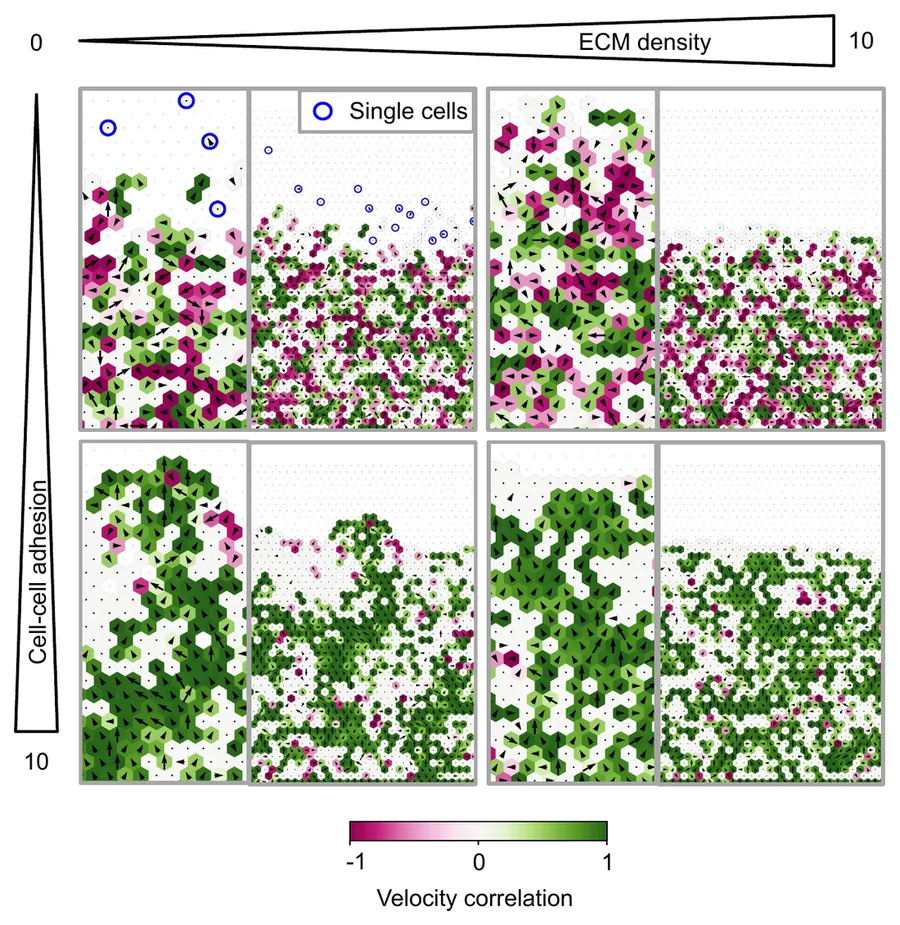
Grid of simulated invasion fronts: with low adhesion and low matrix density, cells scatter and single cells escape; with high adhesion, cells move as large coordinated groups.
Simulated invasion fronts for increasing matrix density (left to right) and cell–cell adhesion (top to bottom). Color shows how strongly neighboring cells move together; circles mark cells that escaped alone. Simulations for Ilina et al., Nature Cell Biology 2020.

02 · Cancer invasion

How tissue confinement shapes cancer invasion

QuestionBreast cancer cells invade surrounding tissue either as cohesive groups or as single cells. What decides between the two?

What we foundWith Peter Friedl’s group, we combined organotypic culture, intravital microscopy and cellular automaton simulations. Three-dimensional tissue boundaries regulate cell density and keep cells moving collectively even when cell–cell junctions are weakened; single cells escape only where free space opens up. In a follow-up study, the model predicted that cells can invade along tissue clefts without degrading the surrounding matrix, which experiments confirmed.

NowI lead the modeling in the ERC Advanced Grant subLETHAL, which extends this work to how invading cells respond to therapy.

PapersNature Cell Biology 2020 · J Cell Sci 2023

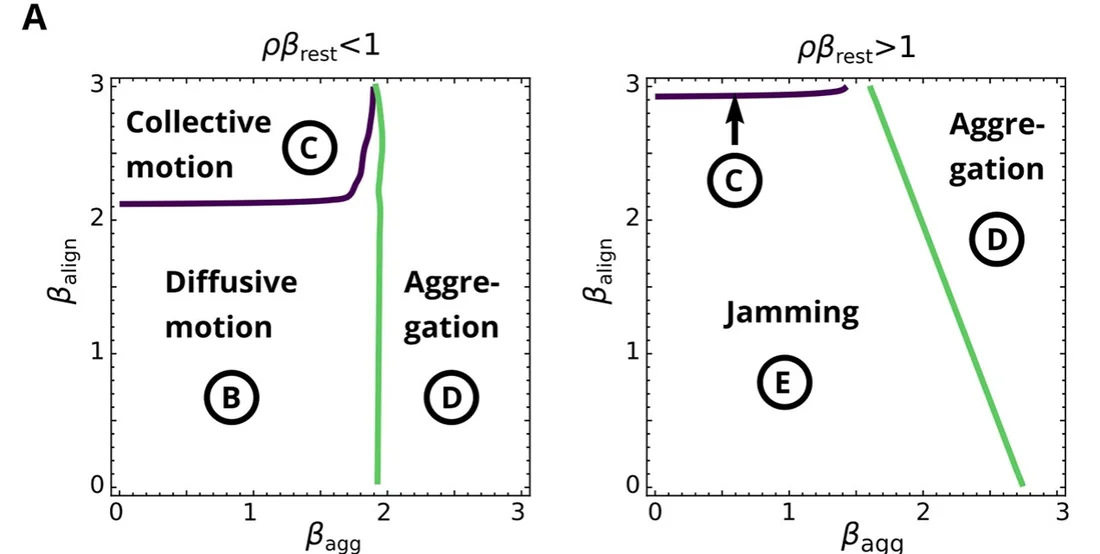
Two phase diagrams of a lattice-gas model, spanned by alignment and adhesion strength, showing regions of diffusive motion, collective motion, aggregation and jamming.
Migration modes predicted for the BIO-LGCA as alignment and adhesion strength vary. Adapted from Deutsch et al., PLOS Comput Biol 2021 (CC BY 4.0).

03 · Collective behavior & methods

From local rules to collective behavior

QuestionCells and animal groups coordinate their movement without a leader. Which local interaction rules produce collective behavior, and how can we build discrete models that we can analyze and trust?

What we foundBIO-LGCA, a lattice-gas cellular automaton framework I helped develop, derives interaction rules from biophysics or data and predicts collective phases such as aggregation and jamming by mean-field analysis. We showed how such lattice models can produce artificial checkerboard patterns and how to prevent them. In a recent preprint, a rule in which an agent occasionally follows a strongly deviating neighbor triggers cascades of reorientation that make swarms more responsive while keeping them cohesive.

PapersNew J Phys 2020 · PLOS Comput Biol 2021 · BIOMATH 2023 · arXiv 2026 · biolgca software

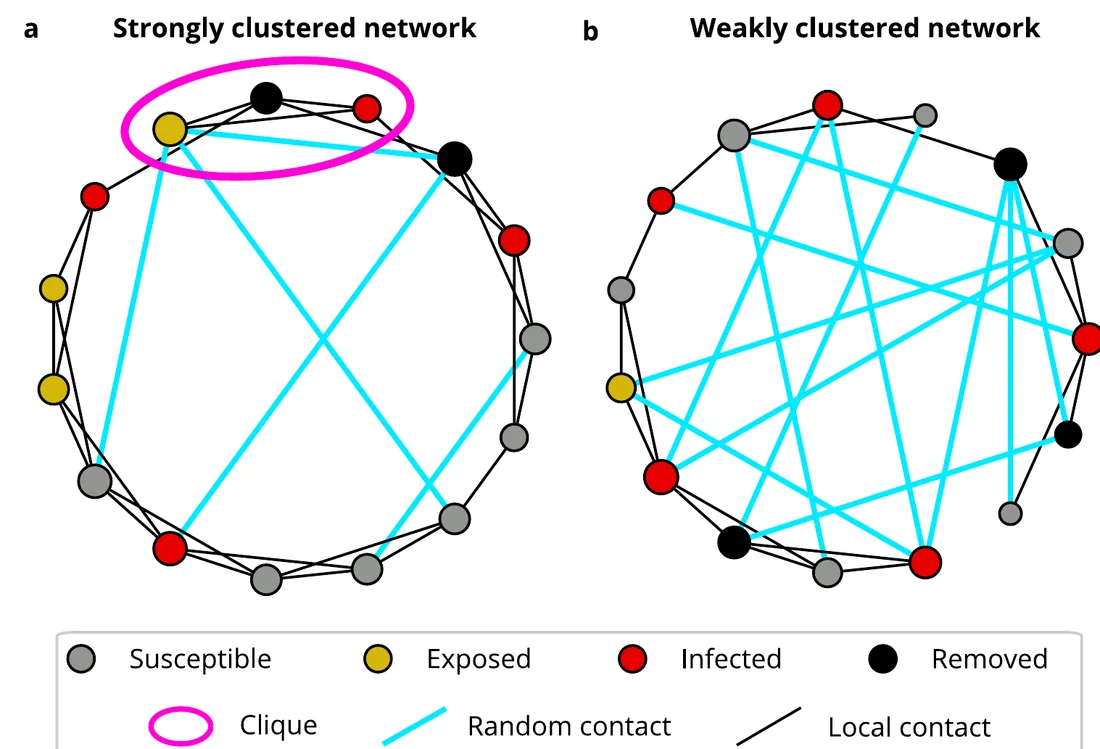
Two ring-shaped contact networks: a strongly clustered one with few random long-range links and a weakly clustered one with many.
Strongly and weakly clustered contact networks in the model. From Syga et al., Scientific Reports 2021 (CC BY 4.0).

04 · Epidemics

What contact restrictions changed in COVID-19 transmission

QuestionDuring the first COVID-19 wave in Germany, non-pharmaceutical interventions changed how people met. Which features of the contact network did they change?

What we foundCombining an agent-based model on a small-world network with Bayesian inference, we found that the interventions mainly removed random, long-range contacts and increased clustering. This switched the epidemic from exponential growth to a regime of constant new cases, in which the disease spreads like a wave at a speed that mean-field theory predicts.

For a general audience, I co-authored the book Mathematik der Pandemie (Springer, 2022).

PapersScientific Reports 2021 · Mathematik der Pandemie, 2022

Publications

All publications are on Google Scholar and in my CV.

Research software

Python · open source

biolgca

I developed this lattice-gas cellular automaton package during my doctorate. It supports simulations of collective cell behavior and is used in publications and student theses.

Explore biolgca
In development · AI-assisted modeling

Morpheus.AI

We are developing and evaluating a human-supervised LLM workflow for constructing and refining multicellular models. The aim is to compare candidate mechanisms more efficiently; reliability is a research question we are testing.

Test the Morpheus skill

Selected talks

Recent invited seminars and conference talks, mostly on the evolution of phenotypic plasticity in tumors. The full list is in my CV.

  • 2026
    Reinhart Heinrich Award keynoteEuropean Conference on Mathematical and Theoretical Biology, Graz, Austria
  • 2025
    Mathematical Oncology Seminar (invited)Mathematical Oncology Laboratory, University of Castilla-La Mancha, Ciudad Real, Spain
  • 2025
    Workshop on Cell Plasticity in Cancer EvolutionMax Planck Institute for Evolutionary Biology, Plön, Germany
  • 2024
    Integrated Mathematical Oncology Seminar (invited)Moffitt Cancer Center, Tampa, FL, USA
  • 2024
    European Conference on Mathematical and Theoretical Biology (invited)Toledo, Spain
  • 2023
    Theory Seminar (invited)Max Planck Institute for Evolutionary Biology, Plön, Germany
  • 2023
    Mathematical and Computational Biology Seminar (invited)Centre de Recerca Matemàtica, Barcelona, Spain

Funding, teaching & supervision

Individual funding

  • Postdoc Starter Kit · 2025–2026Principal applicant. €10,000 from TU Dresden’s Graduate Academy for research visits, collaboration and conference activity.
  • State Innovation Scholarship · 2018–2021Recipient of a competitive individual doctoral fellowship funded by the European Social Fund and the Free State of Saxony.

Collaborative projects & roles

  • ERC Advanced Grant subLETHAL · 2022–2027Scientific lead for modeling and lead contributor to the modeling work package on cancer invasion and therapy response. PI: P. Friedl; total project funding: €2.5M.
  • Worldwide Cancer Research · 2023–2025Scientific lead for modeling and lead contributor to the work package on collective therapy resistance. PI: P. Friedl; total project funding: £200,000.
  • FOSTER.AI — Morpheus.AI · 2025–2026Project supervisor for a student research project developing and evaluating an AI-assisted mathematical-model workflow. Total project funding: €10,000.

Teaching & supervision

  • Research supervisionCo-supervision of two ongoing PhDs, seven MSc theses and seven student research projects.
  • Mathematical biology tutorialsFour terms teaching discrete models: programming assignments, classes, feedback and oral examinations.
  • Seminars & workshopsCo-organized seven interdisciplinary mathematical biology seminars and a multicellular modeling workshop.

About me

I came to mathematical biology through physics and a fascination with how simple interactions give rise to complex living systems. My work now connects evolutionary theory, cell-based simulation and experimental cancer research.

I am a postdoctoral researcher at TU Dresden’s Center for Interdisciplinary Digital Sciences. I earned my PhD in Mathematics there in 2024 (summa cum laude), following degrees in Physics.

I also enjoy making mathematical ideas accessible beyond research: I co-authored Mathematik der Pandemie, a popular-science book on modeling the pandemic.

CV (PDF)

Get in touch

I welcome scientific exchange and collaborations on spatial evolution, cellular heterogeneity and treatment response, especially with imaging, cell-assay and single-cell data that can help shed light on tumor evolution and phenotypic plasticity.

Ongoing collaborations address cancer invasion and immunotherapy with the Friedl group (Radboud UMC, Nijmegen, The Netherlands), lung-cancer treatment resistance with the Marusyk group (Moffitt Cancer Center, Tampa, FL, USA), and glioblastoma heterogeneity with the Perez-García group (University of Castilla-La Mancha, Spain).

Students looking for a thesis project in mathematical biology are welcome to get in touch.

Email me
Center for Interdisciplinary Digital Sciences, TU Dresden, Nöthnitzer Str. 63A, 01187 Dresden, Germany